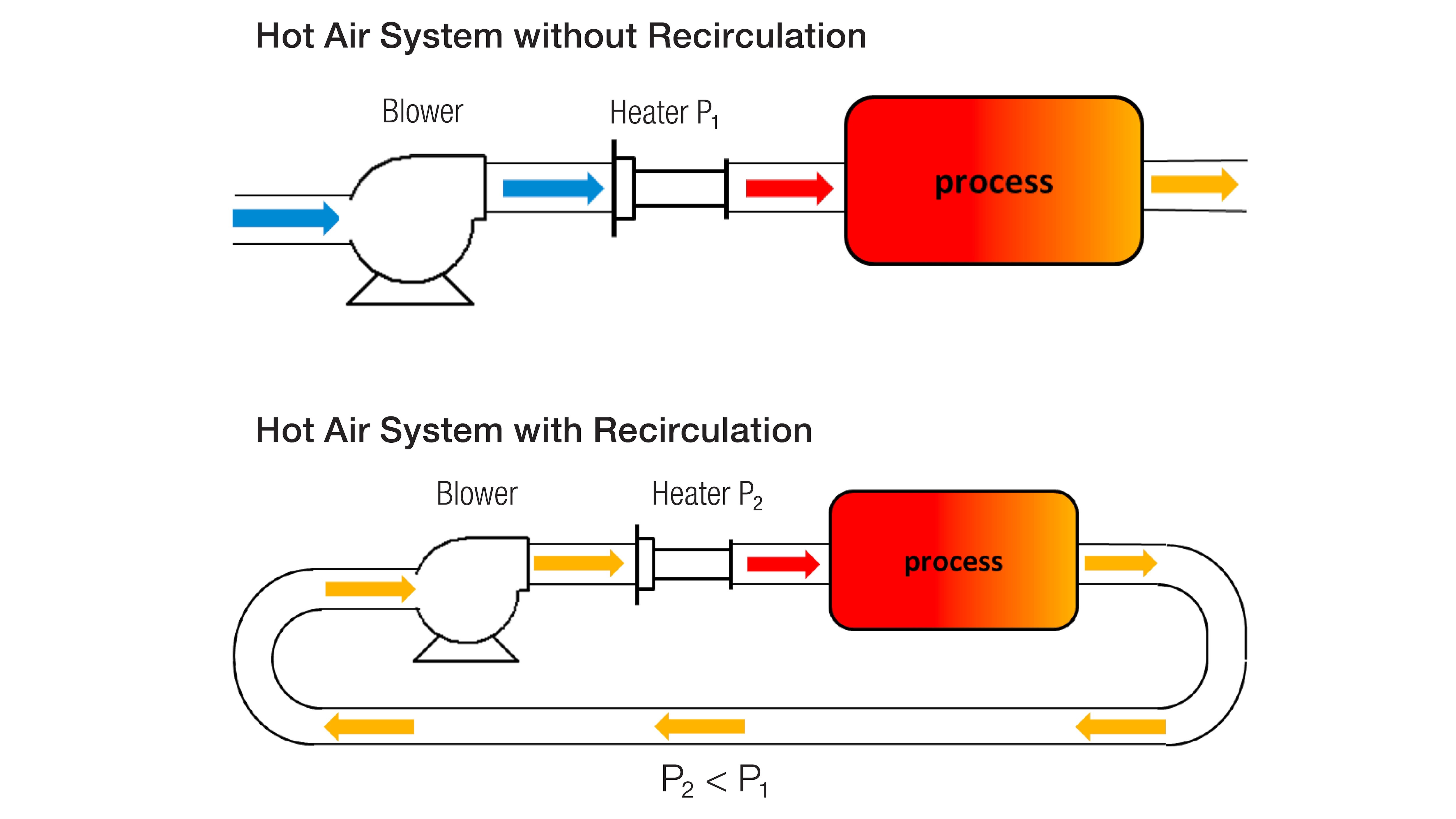
But let's get to the heart of the benefit, the savings. Here is a brief calculation: let's imagine a system that operates 24 hours a day, 250 days a year. To heat an air volume of 4,000 l/min up to an output temperature T2 of 500°C, different powers are required for each temperature (T1) of the incoming air.
T1 = 20°C -> 38.7 kW
T1 = 160°C -> 27.4 kW 29.2% saving compared to 20°C
T1 = 350°C -> 12.1 kW 68.7 % saving compared to 20 °C;
55.8 % saving compared to 160 °C
The potential energy savings are a direct result of these differences. During recirculating air operation, with an input air temperature of 350°C, this results in energy savings of 159,600 kWh per year.
Annual energy consumption with T1 = 20°C > 232,200 kWh.
Annual energy consumption with T1 = 350°C > 72,600 kWh, savings = 159,600 kWh.
Assuming an energy price of 0,12 €/kWh, thanks to the double flange heaters type DF-R the potential saving is 19.152 € per year.
Italian companies, especially at a time like this, are increasingly interested in quality technologies that allow to perform reliable processing combined with energy saving. The industrial areas where air recirculation can be used are many, for example in all those continuous cycle industrial processes where it is necessary to heat ovens and maintain a constant temperature inside them. An interesting application in this sense is well represented by Sapin, a dynamic industrial company based near Milan and active in the production of fire fighting pipes. The application of Leister air recovery technologies has resulted in energy savings of up to 50% in heat treatment ovens (drying and drying) according to the user.